Everyone has the same AI
He opens on the idea that we've all been handed an alien tool. He uses it all day and is still working out how. The bigger point is that everyone has it now, from students to people in their seventies. A few years ago using AI made you stand out. It doesn't any more, so the question for anyone chasing a job or a PhD place is how your work stands out when everyone has the same help.
That's what he means by brain rot. The work you hand in keeps getting better, but your own ability to produce it, or even judge it, stops growing.
“It's no longer a cheat code, because everyone has it.”
Everything starts to look the same
One study asked 25 language models for a metaphor about time, 50 times each. Almost every answer fell into two clusters: time is a river, or time is a weaver. They're decent answers, but there's no spread of genuinely new ideas.
Stories go the same way. Writers given ideas by AI produced stories rated a bit more novel, and those stories also got more alike.
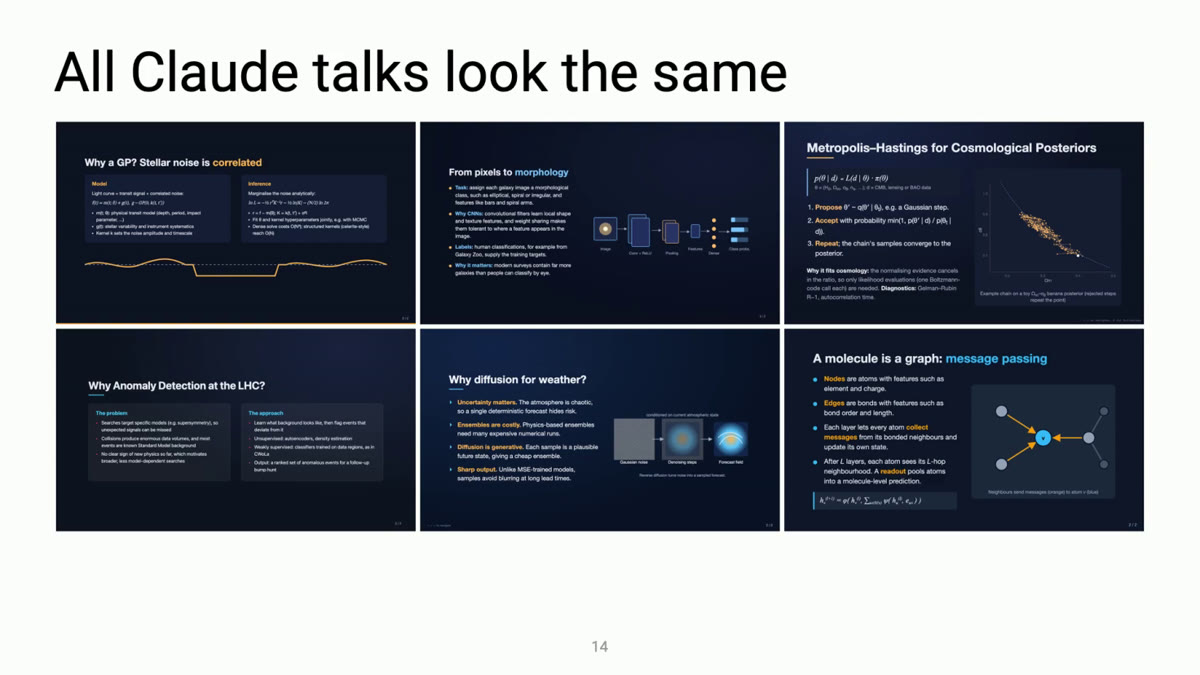
He's seen it in assessment too. Last year's student presentations had a recognisable “Claude style”, down to the font and the colours. On average they were better, and they all looked the same.
Who AI actually helps
The curve collapses because on routine tasks AI helps the weakest people most. When the tool is doing most of the work, skill matters less.
Harder work tells a different story. A study of consultants found AI lifted quality on tasks it could handle, and made people worse on a task just beyond what it could do.
“If you use AI heavily in a simple way, you become average.”
His answer is to stop aiming for the spike and aim for the upper tail. The rest of the talk is about how.
Judgement is the edge
When someone has to judge whether the AI's output is any good, experts pull far ahead of novices using the same tools. Novices also give up much more often when a session goes wrong, because experts can keep steering.
An agent's 14-hour research run 9:50
He let an agent loose on a symbolic regression project of his own for 14 hours. It reported that every goal was met. He knows the field, read the output, and called it “complete garbage”. The agent had confidently sorted equations into “clean” and “mangled”, and the labels made no sense.
Once a task is subjective and there's no verifiable reward to train on, models struggle. He thinks that's also why AI writing has got worse over time.
“The one thing AI can't do is go to jail.”
The AI can never be held responsible for what it produces, so it always comes back to a person. If he uses an output and it contains a mistake, the mistake is now his.
“If you use it to replace yourself, you will get replaced.”
Who decides what to test?
His 14-hour agent wrote plenty of tests and passed every one. What it lacked was the judgement to pick the right tests and the right goals. That taste for which questions to ask is the part he doesn't expect AI to solve soon.
Could you explain it without the AI? 13:33
His own check before delegating anything: could he explain the output, defend it, and find its mistakes without the AI? If yes, he delegates freely, which these days covers almost all of his coding. He also recommends explaining things out loud, because AI makes it very easy to feel like you've understood something when you haven't.
You can stop learning without noticing
About 1,000 high-school maths students in Turkey were split into three groups for practice: no AI, plain ChatGPT, and a ChatGPT tutor that only gave hints. Then everyone sat an exam without AI.
The group that got solutions from ChatGPT did best in practice and worst in the exam, and they didn't think they'd learned any less. The same pattern showed up with adults learning Trio, a Python library: on a quiz taken without AI, people who'd learned without it scored 67% against 50%.
Asking for answers, or for explanations 17:16
His favourite study logged what university students actually typed into ChatGPT while learning Python.
Feeling you've learned isn't learning 18:38
Students who worked the problems before the lecture felt they'd learned less, and tested better.
“If a machine lifts the weight for me, my muscles don't get stronger.”
Psychologists call this desirable difficulty. Being stuck, and feeling stuck, is part of how the learning happens.
Study more, or test yourself? 20:09
Rereading wins if the test is five minutes later. A week later the lines have crossed, and the group who tested themselves remember far more.
The calculator rule
Calculators didn't rot anyone's brain, and we still learn to multiply by hand. His rule for what to hand over comes down to two questions: are you supposed to be learning this skill, and can you check the output?
One more study made the same point: an AI tutor built never to give students the solution, only hints, clearly improved their exam results. All of it points the same way. Use AI to quiz you, take hints when you're stuck, and keep the struggle.
How he actually learns with it
1. Make it quiz you
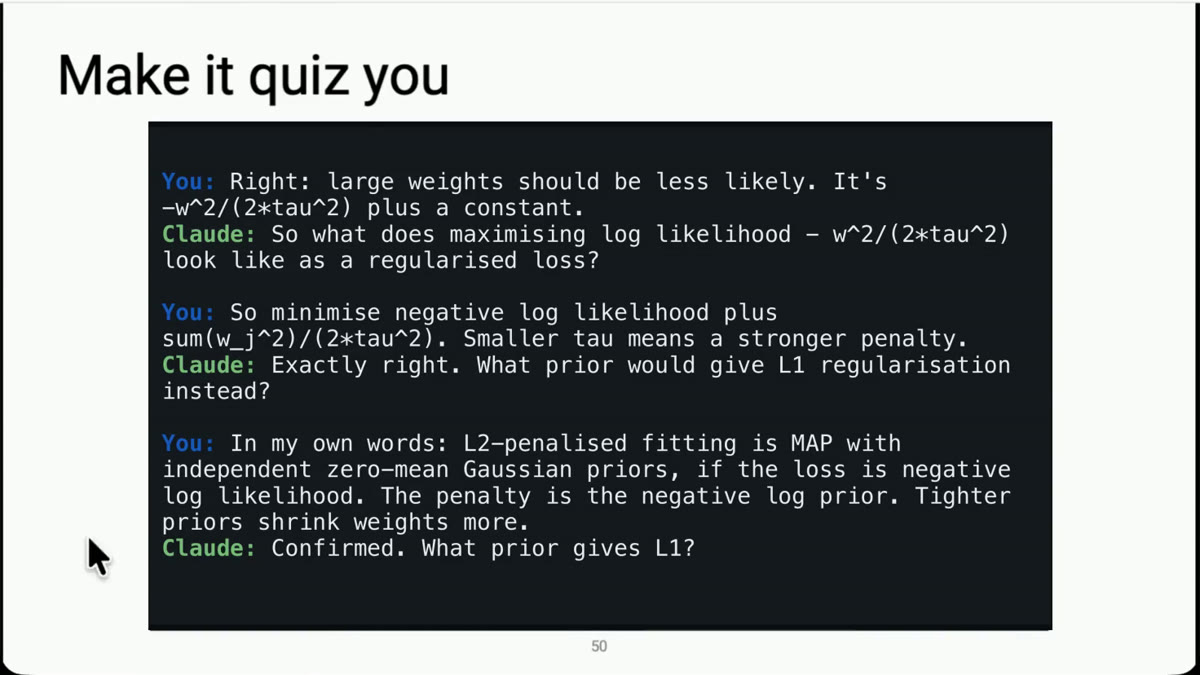
To pick up a new topic fast he has the AI teach him Socratically. It asks him something, he explains it back, it spots the gap and gives the smallest hint, he goes off and reads, and he tries again until he gets it. It's less fun than being told the answer. The research says it sticks.
His demo was a question from last year's exam, the link between L2 regularisation and a Gaussian prior. The prompt matters more than anything else:
Claude: What are you maximising when you do MAP estimation with a prior p(w)?
Someone asked how you can trust an AI tutor when agents produce garbage elsewhere. His answer was that it depends on the material. Give it a research paper and have it tutor you through it and it's decent these days. On niche material, don't trust everything, and treat it as one way of learning among several.
2. Make it build something you can explore 31:12
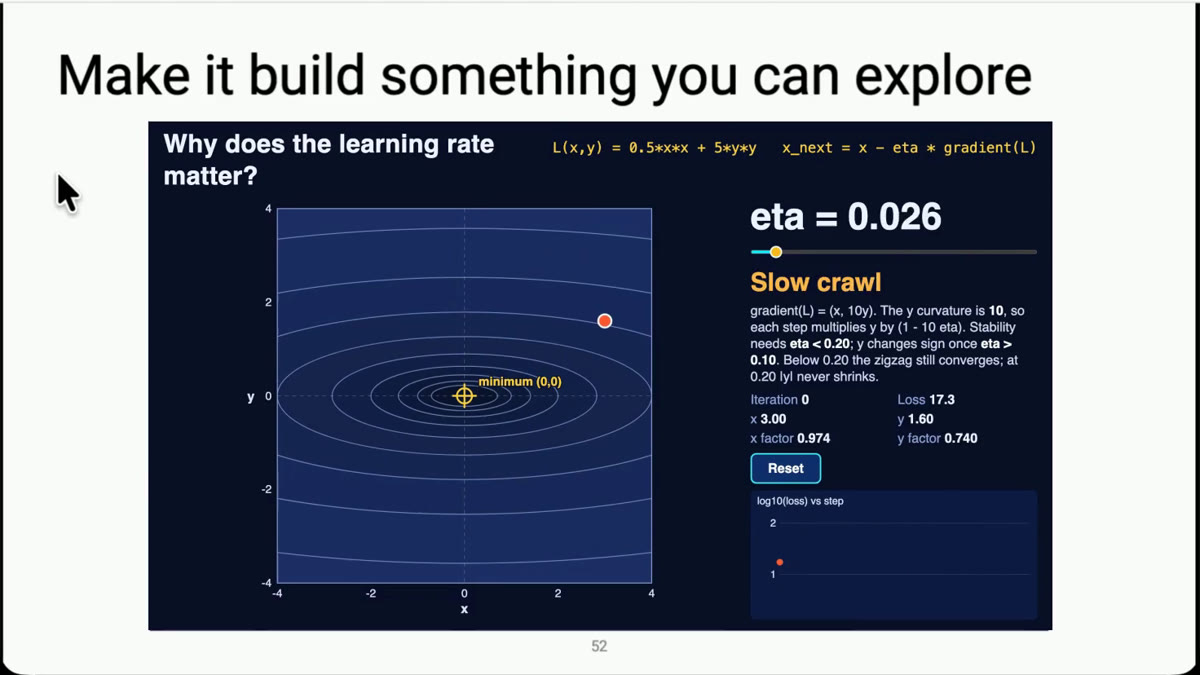
Coding agents write code fast, so he has them build small interactive demos of a concept. He doesn't get why the learning rate matters in gradient descent, so he asks for a single-file web page where he can drag the step size and watch it converge, oscillate or diverge.
3. Make it plot what it built 32:35
“They're brilliant at finding the wrong solutions that pass the tests.”
People take in information fastest from pictures, so instead of reading an agent's essay or its code he asks for a plot, as if it were his student bringing one to a meeting. In his example a model fitted 15 motion-sensor measurements and declared success. The plot showed the fit going straight through the floor, which you see in a second and might take ages to find in the code.
Instructions for coding agents
Coding models have been trained with reinforcement learning to pass tests, whatever it takes. That's where the try/catch around everything comes from, and the overcomplicated solution that happens to go green. Agents read your instructions before every task, so his push back against those habits:
Reproduce bugs with a failing test.
Show a plot before claiming a result.
He named two public instruction files he likes: ponytail by Dietrich Gebert, which cuts down sloppy code, and pstack, an agent workflow by Lauren Tan.
Reproducing the bug first matters because agents love to jump straight in and patch. In the Q&A 51:06 he put it as fixing the symptom instead of the disease: work out exactly where the bug comes from, then fix it.
Write down your standards, then ride the wave
Put your standards in your global system instructions. When it's teaching you: quiz me, make me work, don't just explain. When it's coding: start from a public example. Writing those down forces you to define what good work looks like.
Default AI keeps getting better, so the spike in the curve keeps moving right. Staying in front means staying on the newest tools.
“It's better nowadays to be 50% comfortable with the newest tool than 90% comfortable with a tool from two years ago.”
He isn't pessimistic about AI replacing everyone. The skill he rates highest is learning itself: picking things up quickly and adapting. An intense course is good practice for that even if you never use half of it, because the ability transfers.
“If you're comfortable with your tools, they're probably old. Ride the wave. The only constant is adaptation.”
“AI can automate tons of things. That's great. Now let's solve even harder problems.”
What to try this week
- Make it quiz you“Don't tell me the answer.” One question at a time, the smallest hint only when you're stuck.
- Make it build something you can exploreA small interactive page beats a page of explanation.
- Make it plot what it builtAsk for the picture before you believe the claim.
- Write down your own standardsStart from a public example and edit it until it says what good work means to you.
From the Q&A
He's heard the latest GPT improved after the problem was named, but isn't convinced it gets solved. Writing has got worse, and odd answers that don't make anyone money may run against the labs' incentives.
He won't rule it out: you could feed random noise into a Lean checker until a new proof turns up. It finds some kinds of novel idea.
He still does. Models are good at small steps and at composing ideas, and bad at big leaps or stepping back to see the whole picture, at least in ML research. He generates and directs. They test and code fast.
Depends on the task. For code, an interactive flowchart is great for spotting where the logic goes daft. For data analysis, plots.
On PySR and SymbolicRegression.jl the AI writes all the code and he reads all of it, except tests, which he skims.
People have tried a “lights-off software factory”, with agents taking bug reports and feature requests and no humans. It holds up for three to six months, then the codebase deteriorates under technical debt. Human oversight still matters, and software runs about three years ahead of maths, so it's a preview for other fields.
Code and maths have checkable rewards, like a compiling Lean proof or passing unit tests. Writing is subjective, and there's no simulated reader to reward good prose, so there's no loop to improve it. Early models stayed closer to human-written training data.